“You weren’t there.”
Agnes Shakespeare’s grief coalesces into those words directed at her husband Will. Despite Agnes’s ministrations and skill in herb lore, she could not save their eleven-year-old son Hamnet from the plague.
William was working as an actor and a playwright in London when he got word that his daughter, Judith, Hamnet’s twin, was seriously ill. By the time he rode back to Stratford, he found a recovered Judith. But Hamnet had died unexpectedly.
Agnes refuses any kind of comforting, not from her in-laws, her children, and least of all, from her husband. She hardens her heart to Will because she can’t bear the grief. She is frozen in sadness.
Back in London, Will considers suicide. Mostly, though, he works. He writes.
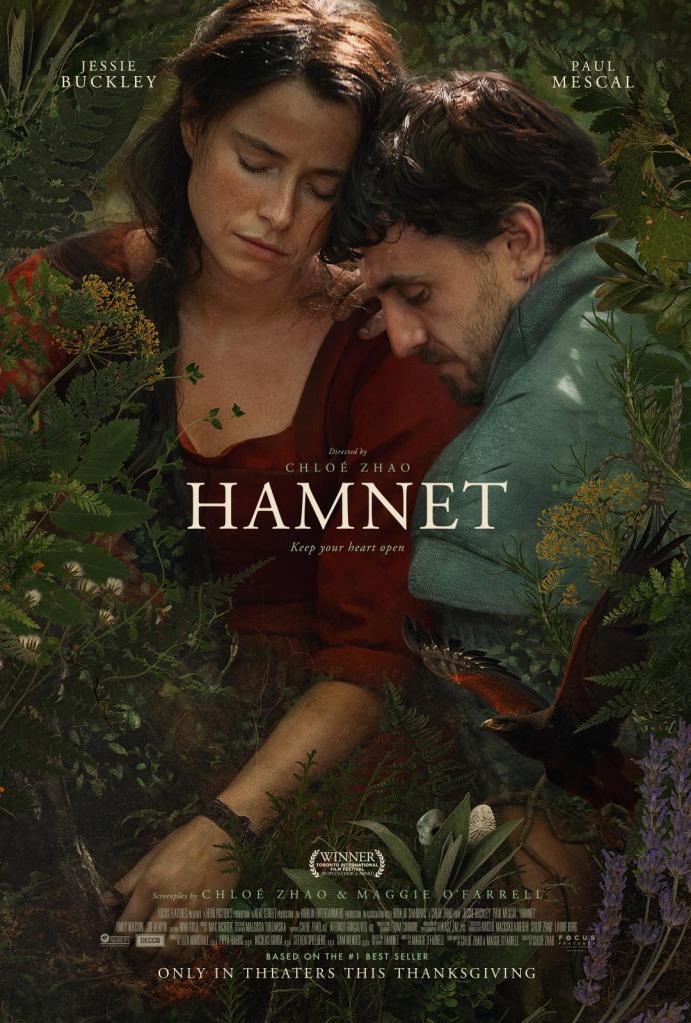
This is the crux of the movie Hamnet, adapted from Maggie O’Farrell’s 2020 book. O’Farrell and director Chloe Zhao co-wrote the screenplay. Jessie Buckley plays Agnes. Paul Mescal plays Shakespeare. Jacobi Jupe is Hamnet.

The movie touched my heart and expanded my vision of the intellectual and emotional possibilities that Art can bring about. Crazy as it sounds, watching Shakespeare struggle to write convinced me that my struggle to write is worthwhile.
Agnes’s and Will’s estrangement last for several years. Her curiosity piqued by a flyer for Shakespeare’s latest play, Agnes goes to London’s Globe Theatre to see it. The play is Hamlet. Initially, she is angry that the players would speak her son’s name. How dare they?

(We are told that in Shakespeare’s time, Hamnet and Hamlet were interchangeable names. I don’t find this outlandish because I had a Chinese teacher who couldn’t differentiate the initial L and N sounds. I asked Dr. Yang if a Chinese character was pronounced long or nong. And he said, “Yes.”)
Hamlet mounts the stage. He is a handsome, taut-bodied young man. There is a shock of recognition on Agnes’s part – and ours – that had Hamnet had a chance to grow up, he would have looked like this glorious man. In a sense, Hamnet still lives.

Shakespeare himself plays the ghost of Hamlet’s father. He tells his son how he was murdered. He describes the poison coursing through his veins, the sores erupting on his body. Agnes recognizes the depiction of Hamnet’s plague-afflicted body.
When the ghost must leave, he bids his son an emotional farewell. (“Adieu, adieu, adieu. Remember me”) Agnes is moved by the ghost’s feeling for his son. It’s as if, in this alternate universe, Will had been there.
In the final act, when he knows he has been poisoned, Hamlet proclaims that the poison is overpowering his body, that there is nothing he can do. “I am dead,” he says. It’s an indirect way to reassure Agnes that she had done everything she could for Hamnet.
Dying, Hamlet falls to his knees. He reaches his arm out toward the audience. Almost reflexively, Agnes reaches her arm toward him. They nearly touch. Then, one by one, the rest of audience raise their arms to Hamlet.

Agnes tears up when Hamlet breathes his last. She then sees that everyone around her is weeping for Hamlet/Hamnet. The realization that not just Will, but this audience, and every audience in the future, will share her grief unjams the ice dam that had blocked her heart. Through this communal sharing of Hamlet/Hamnet’s story, Agnes finally let go of her internal narrative that her son died alone, mourned only by her.
“You weren’t there.” We have all felt that isolation when no one understands how we feel or know what we care about. The issues range from the trivial to the mortally serious. Bill Clinton famously said, “I feel your pain.” The potency of that statement is the acknowledgement to voters that he knows they are hurting, not that he can really feel what they are feeling.
An event almost forty years ago sticks in my mind. I had been divorced some years. I was a young physician establishing a practice. I was also raising a son. What I most wanted was to have a partner. I was a doctor, a mother, a colleague, a boss. No one thought that I needed love in my life. I felt so alone.
One day Gail, a cardiologist, invited me out for a drink. We chitchatted. She stopped me in my tracks with, “How’s your love life?” Even though it’ll will be several more years before I find Bill, her recognition of that vital need endeared her to me.
My life-long friend Larry – we met at Washington University – always chuckled at my jokes. I use the past tense because Larry died in 2019. Even if the jokes were groaners, his grunt signaled that he knew I was trying.
But it is not just people who can change your heart by making a true personal connection. Art in any form –a picture, a play, a book, a movie, a blog! – can touch you too.
Bill and I were at the Met in New York City. The opera was Madama ButterfIy. I was in my usual bristle against the racism and sexism of that story. I noticed a shiny trickle of tears on Bill’s cheek. He found Butterfly’s delusional adherence to the obviously false narrative that Pinkerton would come back for her profoundly sad.
Hamlet the play is the art that moves Agnes past her grief. And Hamnet the movie melts our hearts. This is the power of Art.
The movie is also a window into how one makes Art. Not that any of us is going to be Shakespeare, but then, neither is Shakespeare you or me. We each have our own story. And it is worth telling.
They always tell you to write “what you know.” It seemed to have worked for Shakespeare. I had always wondered about, for example, the twins in Twelfth Night. No one could tell Viola and Sebastian apart? Really? I had not known that Shakespeare was the father of twins.
Shakespeare probably got some pointers on how to portray family opposition from the way both his and Agnes’s families disapproved of their union.
I was reminded that even Shakespeare had to work at making art. A short scene showed Will using his fingers and trying out verses to make the iambic meter work. When Agnes encouraged him to talk through his writer’s block, he threw his papers around in frustration. I understand. You and I – and William Shakespeare – have to persist … and rewrite!
Hamnet was an absorbing movie, a powerful emotional experience, and on reflection, a tribute to the transformative capability of a play, a movie, any kind of Art. It was also a validation of my efforts as a writer.
Tell me: What work of Art has moved you?


2 replies on “The Power of Art to Change Your Heart”
❤️
LikeLike
Yet another fabulous essay Cathy. Thank you. Barry
>
LikeLike