I never thought of myself as a memoirist until a friend said it. But of course, I am. My Dr. Bookworm “gonzo book reviews” discuss books, yes, but also describes how my life, actions and outlook change because of those books.
I’ve long wanted to – felt obligated to – write about my family and my experiences growing up in China and Hong Kong. Those worlds no longer exist. The semi-rural landscape of Hong Kong and Shanghai of the 1950s is unrecognizable compared to today’s skyscrapers of steel and glass. I want my grandsons to picture their Grammy as a kid. I’d like them to get a sense of their great-grandparents.

Oh, but I worry. Are my recollections accurate? Is my memory up to the task? Why did I wait so long – after my parents and several cousins are dead? I am haunted by the responsibility to get the story right.


Then I picked up neuroscientist and psychologist Charan Ranganath’s 2024 book Why We Remember: Unlocking Memory’s Power to Hold on to What Matters. I had to pause and take a deep breath when I read this sentence: “Our memories are not etched in stone; they are constantly changing as they are updated to reflect what we have just learned and experienced.”
That’s not all. He tells us that memories are neither false nor true. “They are constructed in the moment (italics mine), reflecting both fragments of what actually transpired in the past and the biases, motivations, and cues that we have around us in the present.”

These ideas are revolutionary.
Ranganath compares the process of remembering to creating a painting rather than taking a photo. In painting a scene, some objects are fairly exact, others are enlarged, still others are moved, added, or eliminated.
Here’s an example. Bill and I sat side by side on the balcony of our Puerto Vallarta hotel this Christmas. We each painted the view in front of us. There’s the ocean, hills in the background on the left, and in front, the beach and palm trees. Beyond that, we used our artist’s license.

My watercolor emphasizes the vastness of the ocean and the pounding surf. I drew in boats – because they were there. Bill’s picture adds atmospherics – clouds, the setting sun and its shining streak of reflection. We both scattered palm trees on paper seemingly at whim.
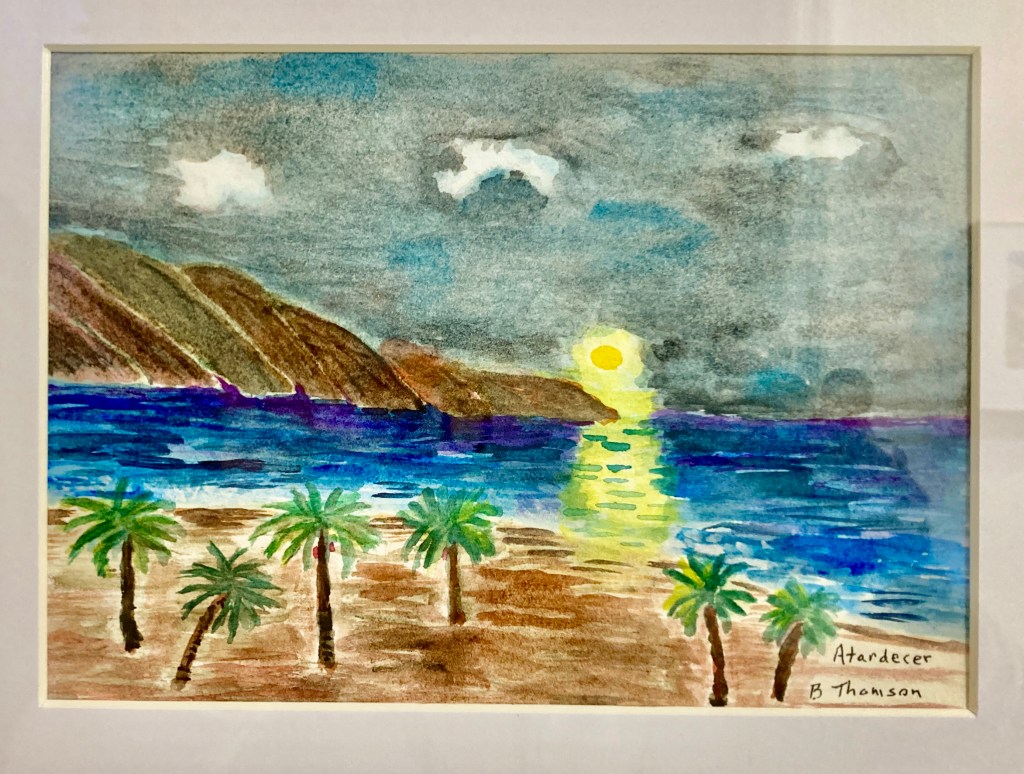
Perhaps the calm sunniness versus the brooding gray clouds reflects our inner state – but I think that might be going too far.
It has taken effort for me to understand this construct of memory. It unsettled me to think that the story of my family will always shift, depending on my perspective and mood at the time I’m writing it.
But once I accept that fact – in the same way that every painting is always an abstraction of the real world – it is incredibly freeing. I will tell the best – truest – story that I can, knowing that it could –WOULD – change over time and under different circumstances. It is also a tremendous incentive to get it down on paper NOW, to pin down what I know, even if it’s in the moment and subject to change.
Here is the science behind Ranganath’s assertions:
Our brains are not full of discrete memory packets like individual storage boxes in a bank vault. Each memory is a cooperative venture between the hippocampus (seahorse-shaped, one on each side of the brain) and the default mode network (DMN) (several areas on both sides of the brain that act together.)
According to Ranganath, “the DMN store[s] the schemas we use to understand the world, dissecting the events we experience into pieces so that we can use them in new ways to construct new memories. The hippocampus … put[s] the pieces together to store a specific episodic memory.”
Here’s a real-life example. Bill and I went to hear Beethoven’s Ninth Symphony this weekend. My brain has the schema of how symphony concerts work: the audience being quiet, the orchestra tuning up, the maestro keeping the beat, no applauding between movements.
For Beethoven’s Ninth, my hippocampus pulled up some very specific memories. The second movement triggered NBC’s Huntley and Brinkley Report from the 1960s because that music introduced each show. When we came to the choral “Ode to Joy,” – a poem calling for the brotherhood (and I assume, sisterhood) of all peoples – I felt a surge of emotion. The music is uplifting; but this time, a sharp poignancy gripped my heart. “Ode to Joy” is the anthem of the European Union, and I felt for the plight of the yet-to-be EU member Ukraine.
Ranganath makes many of his points about memory using anecdotes from his life. He points out that context – the smells, the taste, the music, the emotions, the “sense of being in a particular time and place,” – changes which memories are accessible to us.
For example, Ranganath has lived his whole life in California. When he is in India to visit grandparents, however, he can access memories and even some of the language that escape him in California.
I have experienced exactly that. Almost twenty years after leaving Hong Kong at age eight, I accompanied my grad student husband there for his dissertation research. We rented a room in an apartment that a woman had advertised. One day, when the phone rang, I picked up. To my surprise, I understood what the caller wanted. I replied, “She’s not here,” in perfect Cantonese tones. Our family didn’t speak Cantonese at home. We spoke Shanghai. I hadn’t heard or spoken Cantonese in a couple of decades. Yet, when nudged by the right context, the memory returns.
Ranganath brought up his daughter’s eighth birthday party as another example. It was memorable because it was so disastrous. Rain made the grounds muddy, the kids ran amok, and the pinata wouldn’t break. He ended up smashing the pinata with a golf club.
In Why We Remember, Ranganath has connected for me how what I had considered disparate functions are all forms of memory. Learning something new, making a joke, witnessing a crime, comparing boyfriends, or remembering a disastrous Thanksgiving dinner, all depend on memory. We must remember what we already know to recognize the new.
Even imagination – speculating about the future – is a product of memory. Our creative thoughts and images come from fragments of memory that we reshuffle and elaborate on.
Our memory isn’t dutifully plodding through its tasks. It is dancing, skipping, frolicking, doing the jitterbug. Ranganath calls it “time travel.” Yes, our memories take us through time and space, and even into the future, at gravity-defying speed. That’s why, when I was at the Symphony, I could zip from Beethoven to 1960s television to 21st century Ukraine in a blink. We all do it. All the time.
The real-time monitoring of my brain while it is making all its connections at lightning speed is, for me, a lot of fun. It’s very different from my usual worrying and berating myself about what I should be thinking, feeling, and doing. The non-judgmental tone and emotional lightness of the book has carried over to my every thought. What a wonderful difference.
That goes for writing the memoir of my Chinese past – and my American past and present. I will throw off the anxious fetters of impossible exactitude and enjoy the exciting and wonderful “time travels” that my trove of photos, notes and memories will spark. Charan Ranganath’s Why We Remember has convinced me that my mind is more than capable of writing my memoir. Moreover, it’s going to be a great ride!

Tell me: Do you wish your parents or grandparents had written memoirs?

 Dr. Bookworm
5 replies on “The Awful and Wonderful Truth: A Memoirist’s Take on Her Memory”
Thank you, Sue.
LikeLike
Cathy, Very nicely written. I loved seeing you as a little girl!!
Sue Gouaux MA LCSW 314 324 7107 cell smgouaux@gmail.com
LikeLiked by 1 person
no we just talked late into the night about why our responses were so different…it really was a time of insight for me and hopefully for them.there coming in town soon..I’ll ask them
LikeLiked by 1 person
Wonderful you taped your mom. A treasure. Did you and your sisters argue as to whose version is more accurate? 😆
LikeLike
i taped my Mom telling her life story when she was in her 90’s but I wish I had asked so many more questions. My sisters and I did a life scripting exercise..we picked 3 shared: experiences.i.e. day our grandmother died..went to separate rooms and wrote about it..came back together.shated our writings.. You would have thought we each had a very different grandma and that she died 3 different ways.
LikeLiked by 1 person